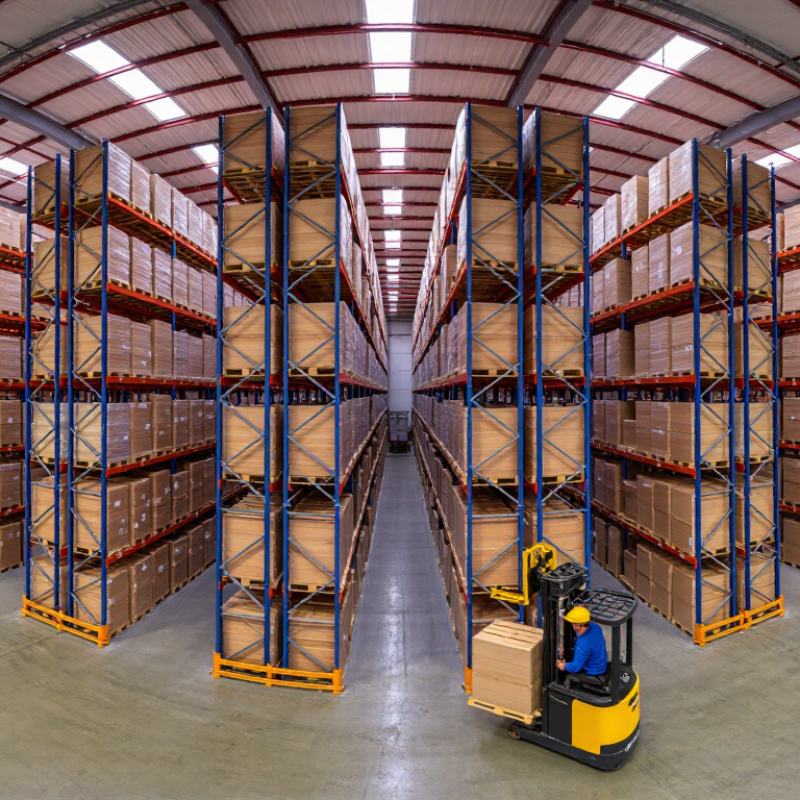
Drive-in Storage is a high-density pallet system built for warehouses handling large quantities of similar products. Forklifts enter storage lanes and place pallets on supported rails. This design removes most access aisles, using depth instead of floor space. It commonly follows a last-in, first-out flow, although drive-through layouts can support first-in, first-out handling.
The market context is significant. Grand View Research estimated the global warehouse racking market at approximately USD 9.34 billion in 2023. It also projects strong growth through 2030. MHI’s 2024 Annual Industry Report found that 55% of supply-chain leaders planned to increase technology investment. Yet automation cannot fix a poorly designed lane. Drive-in Storage still depends on accurate pallet dimensions, disciplined forklift movement, and consistent product rotation.
Kevin Gue, a recognized warehouse-design researcher at Auburn University, captures the central concern: “Storage density is valuable only when it supports the flow of goods.” That principle deserves attention. A compact lane may hold more pallets, but it can also slow picking and complicate stock visibility. One blocked position can affect an entire bay. Small mistakes become expensive.
This guide explains how Drive-in Storage works, where it performs well, and where it can disappoint. It examines pallet access, loading patterns, safety considerations, and practical warehouse planning. The system is not perfect. It is a trade-off. When product uniformity and high volume matter more than immediate access, that trade-off may be worthwhile.
Drive-in storage, often called drive-up storage, lets a customer bring a vehicle along an access lane and park beside a unit’s exterior door. The door is commonly a roll-up style, so boxes, tools, or furniture can move straight between the vehicle and the unit. Less carrying. It differs from indoor storage, where customers usually enter a building and walk through hallways. The term can be fuzzy, though: facilities may use it for slightly different layouts.
The 2024 Self-Storage Almanac estimated that the United States had about 2.1 billion square feet of rentable self-storage space. That figure covers the wider industry, not drive-in units alone. It helps explain why layouts vary: some sites offer rows of vehicle-accessible units, while others combine them with indoor spaces. A short path from car to door can make loading bulky items easier, but weather exposure and unit conditions depend on the facility. Check the door clearance, lane width, and access hours before renting.
Tips: Visit with the vehicle you plan to use, if possible. Picture turning into the lane with a loaded car, then opening the unit door without blocking traffic. Ask whether the unit is climate-controlled; drive-up access does not guarantee temperature or humidity control. Also confirm how the gate works after hours. A convenient layout can still feel awkward when the turning space is tight.
| Dimension | Typical Data | How It Works |
|---|---|---|
| Storage system | High-density pallet racking with deep storage lanes | A forklift enters a lane to place or retrieve pallets, which are supported by rails along the rack structure. |
| Loading access | Usually one accessible end per lane | The forklift enters from the aisle and travels into the lane. The lane is generally accessed from the same end for both loading and retrieval. |
| Inventory rotation | Typically LIFO (last in, first out) | The most recently stored pallet is usually the first one available for retrieval. This suits products that do not require strict first-in, first-out rotation. |
| Lane depth | Designed for multiple pallets stored one behind another; depth varies by building, load, and handling equipment | Greater lane depth can increase storage density, but may reduce access to individual pallets and make retrieval more sequence-dependent. |
| Pallet positions | Positions are arranged across multiple levels and lane depths | Approximate capacity is calculated from the number of lanes, pallet positions across each lane, and usable storage levels. Rack and building constraints determine the final layout. |
| Product suitability | Best for relatively uniform loads with several pallets per product or stock-keeping unit | Consistent pallet dimensions and stable loads help ensure safe clearance and smooth forklift travel through the lanes. |
| Space use | High storage density compared with many aisle-based pallet rack layouts | Because forklifts travel into the rack, fewer access aisles may be needed. The trade-off is less direct access to each pallet position. |
| Forklift requirements | Equipment must be suitable for the lane width, rack height, load, and operating conditions | Operators need adequate clearance and visibility while entering, positioning, and reversing from lanes. The rack layout should be matched to the equipment. |
| Key planning checks | Load dimensions and weight, pallet condition, clearances, floor capacity, rack protection, and fire-code requirements | A qualified design and site review help confirm that the system fits the building, inventory, equipment, and applicable safety requirements. |
Values and configurations vary by site; final rack dimensions and capacity should be established through a project-specific design.
Drive-in storage lets a vehicle reach a unit or rack lane directly. Boxes or pallets move a short distance from the vehicle.
Indoor storage usually requires walking through hallways. Drive-in layouts place doors beside access lanes, reducing carrying distance.
Check door height, lane width, turning space, access hours, and gate rules. Bring your actual vehicle, if possible.
Not always. Ask about temperature and humidity control before storing sensitive goods.
Similar palletized goods work well. Examples include boxed supplies, packaged food, building materials, and seasonal stock.
A forklift enters the deep lane and places pallets from the back forward. The nearest pallet usually leaves first.
It stores many similar pallets in limited floor space. Fewer aisles may reduce lighting and construction needs.
Access is limited, especially for mixed inventory. Front pallets may block deeper loads, causing delays during busy periods.
Usually not. Odd shapes, weak cartons, and unstable pallets may need another arrangement.
Use strong, balanced pallets with visible labels. Train forklift operators, inspect rails, and keep inventory records accurate. Mistakes still happen.
Drive-in Storage is a warehouse system that allows vehicles, such as forklifts, to enter storage lanes and place or retrieve goods directly from rack positions. Unlike conventional shelving layouts with open aisles, these facilities use deep, reinforced rack structures that create internal lanes. Their design maximizes vertical and floor space, making them especially useful when storing large quantities of similar products on pallets.
The process is straightforward: an operator drives into an assigned lane, loads pallets from the deepest available position outward, and removes them in the reverse order when needed. Drive-in Storage works best for durable, non-fragile, palletized goods with relatively low variety and predictable turnover, such as seasonal inventory or bulk materials. Its main advantages include high space efficiency, reduced construction costs per storage position, and strong protection from unnecessary handling. However, it offers limited selectivity, requires careful traffic management, and may slow access when different products must be retrieved frequently.

 Aliracking